
ALTCS Arizona: Complete Guide to Eligibility and Home Care Services

Table of Contents
- Understanding ALTCS in Arizona
- ALTCS Eligibility Fundamentals
- Home Care Services and Family Benefits
- Practical Application and Veteran Benefits
- Advanced Strategies for Long-Term Planning
- Frequently Asked Questions
- Taking the Next Step
Understanding ALTCS in Arizona
Understanding ALTCS Arizona begins with recognizing it as the state’s specialized Medicaid program dedicated exclusively to long-term care. Unlike a generic subsidy, the Arizona Long Term Care System, administered by AHCCCS, is specifically designed for elderly individuals, those with disabilities, and people with chronic conditions who require a nursing-home level of care but wish to remain in the comfort of their own homes. At Advacare Homecare, we guide you through every step, starting with the basics of this vital safety net.
The most significant difference between ALTCS and regular AHCCCS medical coverage is the type of care they fund. Standard Medicaid handles acute care, such as doctor visits and short-term hospital stays. In contrast, ALTCS addresses ongoing daily living needs, providing support for activities like bathing, dressing, and meal preparation. The financial landscape also differs; ALTCS eligibility requirements have a higher asset and income limit for married couples compared to single individuals, a crucial distinction that can protect a family’s financial future while securing necessary care.
When it comes to the support provided, ALTCS home care services offer a comprehensive range of benefits that go far beyond nursing home coverage. The program’s goal is ‘Comfort, Care, and Independence All at Home,’ which is achieved through personalized assistance with daily activities right in the residence. As a trusted senior care agency, we help families navigate these complex benefits, demonstrating how a thorough understanding of the program can be the crucial first step in planning for long-term care expenses without depleting retirement savings. This foundational knowledge is essential for building a secure care plan.
ALTCS Eligibility Fundamentals
Understanding the Arizona Long Term Care System begins with mastering the three pillars of qualification: financial thresholds, medical necessity, and proper documentation. Our team believes that securing altcs arizona benefits should not feel overwhelming, and we are here to guide you through every step. ALTCS eligibility requirements focus on both income and asset limits in Arizona, as well as a comprehensive medical assessment to ensure you receive the right level of long-term care coverage.
Income and Asset Limits in Arizona
What are the specific income and asset limits for an Arizona applicant? Arizona enforces a monthly income limit that adjusts annually. For 2024, the individual income cap is $2,829 per month, but applicants who exceed this threshold can still qualify by using a Miller Trust, an income-only trust that diverts excess income. For a comprehensive altcs eligibility guide, the state portal offers detailed breakdowns.
For married couples, spousal impoverishment protections are vital. If you are the community spouse, you can keep a Minimum Monthly Maintenance Needs Allowance, which is the minimum income you can retain to avoid poverty, alongside a protected share of the couple’s resources. We want to emphasize that owning a primary residence does not automatically disqualify you. According to Advacare Senior Home Care, a home is exempt if the applicant or their spouse lives there, up to an equity interest of $713,000 in 2024. This home exemptions rule also protects the residence if a caregiver child lives there, keeping your family secure.
Medical and Functional Requirements
To access ALTCS home care services, the state must confirm that you require a nursing facility level of care. A registered nurse from AHCCCS conducts a Pre-Admission Screening. This PAS evaluates your ability to perform Activities of Daily Living, with a focus on:
- Bathing and personal hygiene
- Dressing and grooming
- Transferring and mobility
- Toileting and continence management
- Eating and meal preparation
The assessment is designed to see if you can safely remain in the community with in-home support benefits rather than moving to a nursing home. Our experience shows that many families are relieved to learn their loved one qualifies for home and community-based services after the PAS is complete, allowing them to age in place.
Required Documentation and Timelines
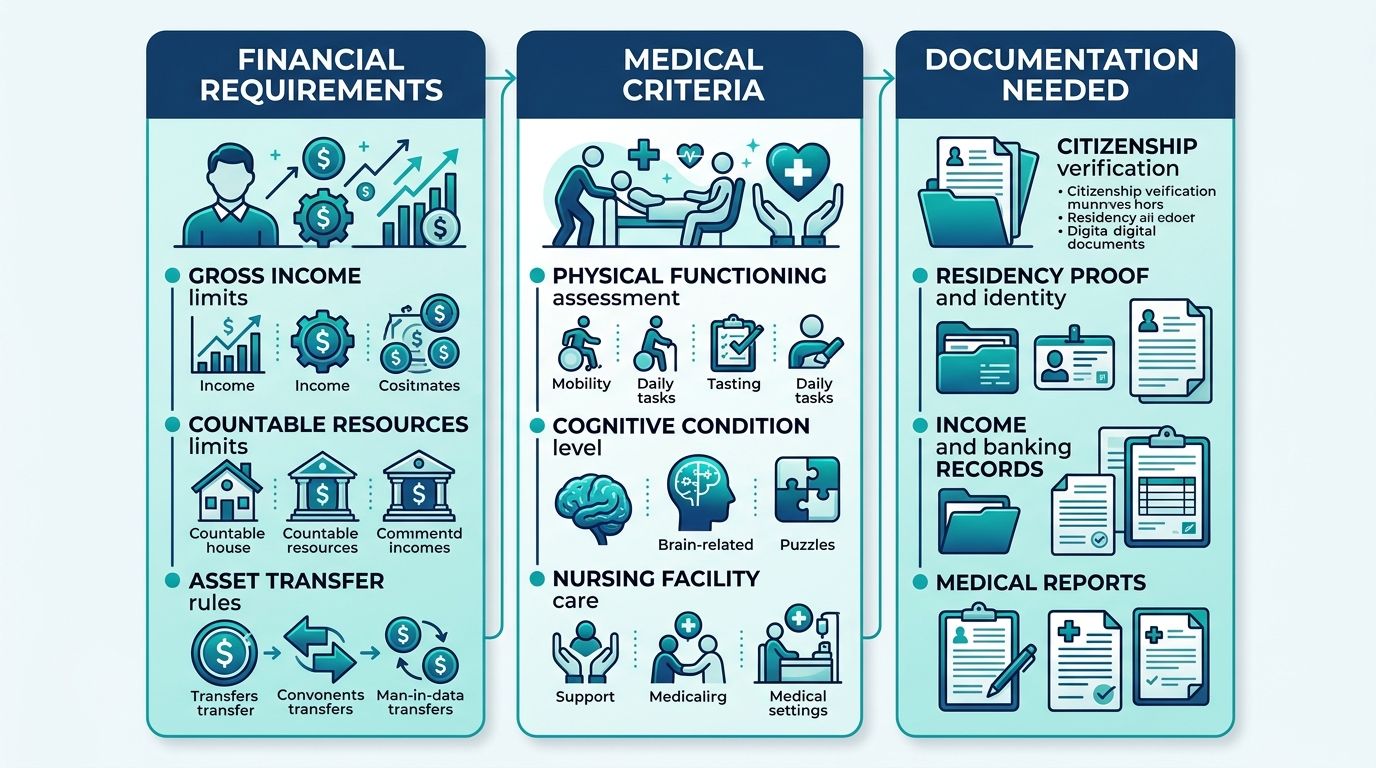
Key eligibility pillars for Arizona ALTCS benefits: financial, medical, and documentation requirements.
What paperwork should you prepare before filing? Gathering the right documentation upfront prevents delays. We recommend compiling the following financial verification:
- 5 years of detailed bank statements
- Pay stubs, tax returns, and Social Security award letters
- Life insurance policies with cash value
- Vehicle titles and property deeds
Once submitted, we help set realistic expectations for the application timeline. The non-medical decision process typically takes between 45 and 90 days. The exact duration depends on case complexity and the prompt submission of all required records.
Home Care Services and Family Benefits
When families begin exploring long-term care options, many assume a nursing facility is the only path forward. In reality, Arizona’s Medicaid program offers a robust alternative that funds care right in the comfort of home. Understanding how ALTCS home care works can open the door to keeping a loved one surrounded by familiarity while receiving professional support. We believe in Care, Comfort, and Independence All at Home, and that journey starts with knowing which services the program covers.
Exploring Home and Community-Based Services (HCBS)
Arizona’s ALTCS home care services are designed to help qualified individuals avoid institutional placement by bringing care directly to their residence. According to the Arizona Long Term Care System (ALTCS), the program covers personal care that includes bathing, grooming, dressing, toileting, and mobility assistance, essentially the hands-on support needed for daily living. Skilled nursing services also fall under the HCBS umbrella, encompassing medication management, wound care, injections, and ongoing monitoring of chronic conditions like diabetes or heart disease. When a physician prescribes therapies, ALTCS can authorize physical, occupational, and speech therapy sessions aimed at maintaining or improving functional ability.
The Family Caregiver Program Explained
Our Family Caregiver Program empowers relatives to step into a professional caregiving role while receiving compensation for their dedication. Through Arizona’s Medicaid system, spouses, adult children, and other relatives can be hired as paid caregivers, but the funding flows through a state-approved home care agency rather than as a direct cash payment. This structure ensures proper tax withholding, liability coverage, and compliance with AHCCCS standards. We guide you through every step of this process, starting with verifying insurance benefits and confirming that the care recipient meets the functional needs threshold requiring nursing-level care.
Navigating the Application for Home Care
Applying specifically for home-based care rather than institutional placement starts with a clear request during the ALTCS eligibility requirements process. When an individual qualifies financially and medically for ALTCS in Arizona, the next step is an in-home functional assessment conducted by a case manager. This evaluation determines the number of service hours authorized and the mix of personal care, skilled nursing, or therapy required. At this stage, it is important to explicitly communicate the preference for HCBS so the care plan is built around home and community-based settings by default.
Practical Application and Veteran Benefits
Once a person understands the theory behind Arizona’s ALTCS program, it’s time to act. Navigating the complexities of ALTCS Arizona alongside other benefits like VA Aid and Attendance can feel daunting, but a coordinated approach simplifies the process dramatically. At Advacare Homecare, we guide you through every step, ensuring that no opportunity for coverage is missed while keeping the focus on comfort, care, and independence all at home.
Coordinating ALTCS with VA Benefits
For veterans and their spouses, the potential for overlapping coverage can significantly reduce out-of-pocket costs. The process begins by initiating the ALTCS application with AHCCCS while simultaneously applying for the VA’s Aid and Attendance pension. It’s critical to understand that while VA pension payments are counted as income for ALTCS eligibility requirements, the cost of unreimbursed medical expenses—such as a dependent child’s private health insurance or ongoing home care—can be deducted from that countable income. This strategy often allows veterans to meet the financial threshold necessary for ALTCS approval without disqualifying their VA benefits.
The Role of an Agency in the ALTCS Process
Once you decide to pursue multiple benefits, partnering with a provider becomes invaluable. For ALTCS, the state mandates that family caregivers must be hired through an approved provider agency. Choosing an experienced senior care agency ensures these complexities are handled seamlessly. Through our Family Caregiver Program, we handle the ‘agency requirement’ by managing caregiver credentialing, background checks, and continuous supervision, which simplifies the state-mandated employer responsibilities that could otherwise overwhelm a family.
Common Application Pitfalls to Avoid
Watch Out: Improper Asset Transfers. The 5-year look-back period for ALTCS is strict. Selling property below market value or giving away assets can trigger a penalty period of ineligibility. Always consult an elder law attorney before restructuring any finances.
Watch Out: Incomplete Medical Records. The physician-completed PASRR is non-negotiable. Incomplete forms or a failure to clearly attest to the need for a nursing facility level of care is a top reason for denial. We coordinate directly with medical providers to ensure thorough documentation.
Advanced Strategies for Long-Term Planning
Now that you have a feel for how ALTCS fits into your long-term care picture, let’s walk through two of the most important—and most misunderstood—planning safeguards: protections for the spouse who stays at home, and what happens if you’ve shared money or property with family in recent years. Understanding ALTCS eligibility requirements early in the process is the best way to avoid surprises and protect your family’s financial well-being.
Spousal Impoverishment Protections
When one spouse enters a care facility, Arizona’s ALTCS program uses the Minimum Monthly Maintenance Needs Allowance (MMMNA) to prevent the community spouse from being left without enough income. For 2024–2025, the state sets this income floor to guarantee the spouse at home keeps at least a minimum dollar amount each month, preserving stability instead of requiring a complete spend-down. We start the calculation by identifying the couple’s total countable income at the time of institutionalization and then subtracting the institutionalized spouse’s personal needs allowance.
Navigating the Look-Back and Penalty Periods
Arizona applies a 60-month (5-year) look-back period to every uncompensated transfer made before applying for ALTCS. When the state finds a gift or asset transfer for less than fair market value during that window, it calculates a penalty that delays your eligibility for ALTCS home care services. The formula divides the total uncompensated amount by Arizona’s average monthly private-pay nursing home rate—using 2024 figures, a $90,000 transfer divided by approximately $9,000 per month results in a 10-month ineligibility period. The penalty clock starts on the later of the transfer date or the date you would otherwise be eligible, and it runs prospectively from there.
Several legal exceptions do not trigger a transfer penalty. Transfers to a spouse, to a blind or disabled child, or into a trust for the sole benefit of a disabled individual under 65 are generally permitted under AHCCCS rules. When you’re ready to move from planning to paperwork, the official altcs application guide provides the forms and checklists you’ll need. Armed with the basics and these advanced strategies, the natural next move is to begin assembling your application—and we’ll show you how.
Frequently Asked Questions
How does the Four Steps process work when I call Advacare?
We begin with a friendly initial call to understand your needs, then schedule an in-home assessment. Next, we match you with a compatible caregiver and provide ongoing monitoring to ensure comfort and confidence.
Can my family member get paid to care for me?
Yes, through our Family Caregiver Program, a qualifying relative may be paid by certain insurance plans or through ALTCS home care services. We handle all the paperwork and approval steps for you.
Is Advacare a government agency that handles ALTCS?
We are a private provider, not a government agency, but we guide families through the complex ALTCS eligibility requirements and application process to make it manageable.
Are your caregivers trained and insured?
All Advacare caregivers are fully licensed, insured, and undergo thorough background checks and regular ongoing training.
How quickly can home care services begin after approval?
We set practical expectations and can typically start services within 24 to 48 hours following approval.
Taking the Next Step
As you consider your options for in-home support, we want you to feel confident that compassionate help is close to hand. Advacare Homecare’s Home Care with Heart promise means your family will be treated with the same respect and warmth we would want for our own loved ones. Whether you are curious about ALTCS eligibility requirements or wondering how ALTCS home care services work in Arizona, our team is ready to walk you through every detail.
We take the guesswork out of insurance and VA benefit navigation so you can focus on what truly matters: comfort, care, and independence all at home. From our offices across Arizona, our licensed and insured caregivers are available to begin the Four Steps to Comfort and Confidence. Reach out today — we are here to listen and to help you start the journey, one caring step at a time.
| Feature | ALTCS | Regular Medicaid (AHCCCS) |
|---|---|---|
| Target Beneficiary | Elderly, physically disabled, or developmentally disabled requiring nursing facility level of care. | Low-income adults, children, pregnant women, and families. |
| Care Setting | Nursing home, assisted living, or home and community-based services (HCBS). | General community settings, 100% federal poverty level adults, some individuals with serious mental illness. |
| Financial Eligibility | Stricter limits; considers both income and assets. Complex look-back period for asset transfers. | Primarily income-based; broader eligibility for children and pregnant women. |
| Family Caregiver Payment | Yes, family members can be hired as paid caregivers under specific programs and agencies. | Minimal or no direct payment for family caregivers. |
| Service Category | Covered | Not Covered |
|---|---|---|
| Personal Care | Bathing, grooming, dressing, toileting, mobility assistance. | Chore services not related to health, strictly social companion care. |
| Skilled Nursing | Medication management, wound care, injections, monitoring chronic conditions. | 24/7 private duty nursing without prior authorization. |
| Therapies | Physical, occupational, and speech therapy prescribed by a physician. | Massage therapy solely for relaxation. |
| Caregiver Payment | Spouses, adult children, and other relatives may be eligible as paid providers. | Cash payments directly to the family bypassing an agency tax ID. |
This article was researched and written with the assistance of AI tools.
Resources
- Start a Non-Medical Senior Care Agency Step by Step
- Find Reliable In-Home Senior Care in Arizona
- Get Paid as a Family Caregiver Through ALTCS Arizona
- Apply for VA Aid and Attendance Home Care Benefits
- Become a Paid In-Home Caregiver in Arizona
- Understand ALTCS Home Care Coverage and Eligibility
- Follow the ALTCS Enrollment Process in Arizona
- Apply for AHCCCS Medical Assistance Online in Arizona
- Find AHCCCS ALTCS Eligibility Information Online